I arrived a bit late so missed the start, but was really glad I was there in time to hear James Davies talk about his work within the Google Cultural Institute.
James set up the Google Art Project, which has an amazing system for searching and curating collections of works. It goes very deep and very wide, it was helpful to have the system explained to us. (He referred to people who work at Google as ‘Googlers’, which I couldn’t help thinking sounds like a Harry Potter-ism!)
The Cultural Institute has grown from a small team who are passionate about art, allowing the freedom to take highly innovative approaches to development. The Art Project integrates their street-view technology, allowing for walk-through views of the galleries and museums that are archived. Some images are depicted using megapixel technologies, taking 24 hours to scan. This allows for a powerful zoom-ability to really get into the detail of the images.
Key terms he used that I particularly enjoyed were ‘semantic connectivity’ and ‘scholarship & serendipity’ – nice!
Whilst the technology behind the project is complex, the interface for the user is not. Expert knowledge isn’t needed.
All that the Institute does supports Google’s core mission: which us about organising information, being accessible and useful, mainly through search.
Whilst of course it has limitations, so do physical visits, such as cost, culture, distance, and language barriers.
IMPORTANTLY, THIS IS AS WELL AS, NOT INSTEAD OF
I have recently reiterated this constantly, especially when people say they prefer books to blogging. It is not a case of choosing one or the other, we can have them all and use them as we will. Transliteracy is something Sue Thomas talks well about:
Transliteracy is the ability to read, write and interact across a range of platforms, tools and media from signing and orality through handwriting, print, TV, radio and film, to digital social networks.
TECHNOLOGY CAN BRING SOMETHING NEW.
The conversations that ensued were complex and fascinating. I make no attempt to collate them here. But I do need to reflect about how the day has impacted on my thinking.
The artworks catalogued are all tangible, physical things – objects such as paintings and sculptures. At present no ephemeral or experiential works are included. I believe that needs consideration, not only as a documentation, but as a way of investigating audience responses. The interface allows for comment books to be included, soundbite interviews and videos, it has the potential to share with googlers the next best thing to the real. Most of the world we experience is mediated anyway, this is just another portal into it.
What is particular about viewing anything on a computer is our looking in, as opposed to looking out. The fact that Google Hangout is integrated into the site means people can discuss works in real-time, or enjoy live lectures with Q&A. Fab. Another dimension adding to visitor experiences.
All of this thinking has flipped me back to when I did my MA in Fine Art. I’d be very interested in writing a reflection of the then and now – what has changed, and in what ways? I remember when people first used mobile phones it sometimes seemed they were talking to themselves as they were held discretely, but no-one hides it now. Them there’s the simulacra as per Baudrillard – does it matter any more that the boundary between real and virtual is disappearing? And as for Foucault, are we living IN a panoptic machine now?
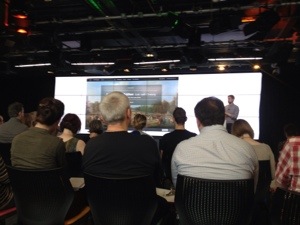
Thanks to CVAN for a Grand Day Out, it was inspirational.
 Carolyn Black
Leave a reply to carolyn black Cancel reply