Below is a piece of writing I did when I was deeply engaged with exploring stones. I still spend quite a lot of time with them! As often happens, I was looking for a particular file on my computer and discovered this writing.

(Written in 2021)
I’ve been thinking about the scale of things. We talk about scale in relation to the importance of things, some things don’t matter very much, whilst others matter SO much they are ‘off the scale’.
We use a scale to measure how good something is, or how bad. We also talk about scale in terms of size, whether something is small or large.
Scale is of course relational. Something is only small in comparison to something larger. We see this ambiguity in art quite often. When we view small images on the screen, or in a book, of a painting, we have no idea of scale. When we see it in real life it can be shockingly huge, or disappointingly small. Does size matter? If it does, why? One might think it matters because bigger things are often more expensive, when it comes to art. But a diamond can be tiny yet phenomenally expensive.
When my kids were little, I used to read them the book by Janet and John Ahlberg about a skeleton family. I loved the fact that it began in a small, dark cupboard under the stairs, in a small house, in a small village, next to a small town, part of a big country, planet and the universe.
Sometimes we humans live in a small cupboard. We lose sense of the beyond, the other side of the door. Sometimes we feel safer that way and other times we feel constrained by the small space we are in. The pandemic has been like that.
I originally titled this text ‘stone in pocket paper in hand’. I came to my studio to draw the stone on the paper. The stone was small – it fitted in my pocket. The paper in my hand could be small, or big, because paper can be folded. Stone cannot be folded by my hand.
But as I prepared to do the drawing, I absent-mindedly picked up another stone from my worktable. I held one in each hand.
Which meant I had two stones – one in my left hand and the other in my right. The paper was left, unmarked, on the table. As I felt the stones, turned them in my hands freely, they shared their history with me.
Some of the feelings I had were purely physical. They are different – one has rounded edges and the other has quite sharp fractured edges; one has several faces of similar proportion and will sit flat on most of those faces, while the other has lots of small details, many protrusions, and broken parts. It only settles happily on three, maybe four sides, yet the smooth one settled easily on almost any plane.
On top of the sensory experience of holding these stones is the knowledge I have of the stone’s past. They have a recent history, in the time that they had been with me, and another, long before then. Like items in a museum, they have provenance. The one in my left hand came to me from Sweden, posted by Eva, a singer with an amazing voice, who allowed me to use her song in a film that I made. The film was about the River Severn, a place that is very important to me. This stone travelled across the world to my house, in a small village, in a small county. Eva found it in a stream near where she lives. That stream connects to Sigrid’s well. Sigrid was a well-known Swedish queen, mentioned in the Norse Sagas. I sent her a stone from the Severn.
Eva’s stone is clearly from a river. It’s very rounded and smooth, having travelled on its course and been buffeted and bounced along the riverbed. It has tiny cracks and crevices that my nail catches on occasionally. There are stains of different stone colours, red and black. It has, what we humans might refer to as freckles. When I rolled it in my hand it comforted me, it nestled neatly into my palm. I rotated it gently, continuously, just as the river did before me. It has a constant sense of imminence yet possesses an ease of settling into any number of positions. Where it can be still. For a while.
Before it came through my letterbox it had been on many other journeys. Its history will likely go back millions of years, which is unimaginable to me. I know that Eva held it in her hand when she chose it, but who else may have held it? When it was larger, did some creature stand on it? Sleep on it? Nibble lichen from it, pluck moss from it? How many other stones has it rattled against on its journey to Sigrid’s well? Which continent was it originally a part of? Where are it’s connected parts that it broke away from? Is there a fossil at the heart of the stone?
Might it have been connected in some way to the stone in my other hand?
The one in my right hand is not as hard, it looks and feels dusty, though not as loose as chalk. It is mudstone, its fragility restrained by its compression. It does possess a level of hardness but is clearly less resilient to being battered than the Nordic stone is. Examine it closely and it looks like a mountain range, a micro-system of a huge swathe of landscape is held in its form. The edges are jagged and sharp. This is a broken, fractured stone, split by impact, as opposed to being rolled along a riverbed. It has come from deep strata, over 25 million years of accumulation, layered in the cliff below which I found it, on the ground. It’s very pale grey, like the river silt of the Severn. It, too, moves in my hand, but not so freely. I need to open and close my fingers around its form to change its position, due to the ragged edges.
When I put the grey stone down on the desk to type this document, a piece broke off. I attempted to carefully reconstruct it, but it will now go forward as two pieces. It is more likely to be ground to dust than the hard stone. They have different histories and different fates.
It’s all about balance between the past and the present, the soft and the hard, and our resilience.
The scale of things doesn’t really matter. We all get ground down, eventually.
And a little addition – as I just found this photo too – a cast of a stone, made of ice.

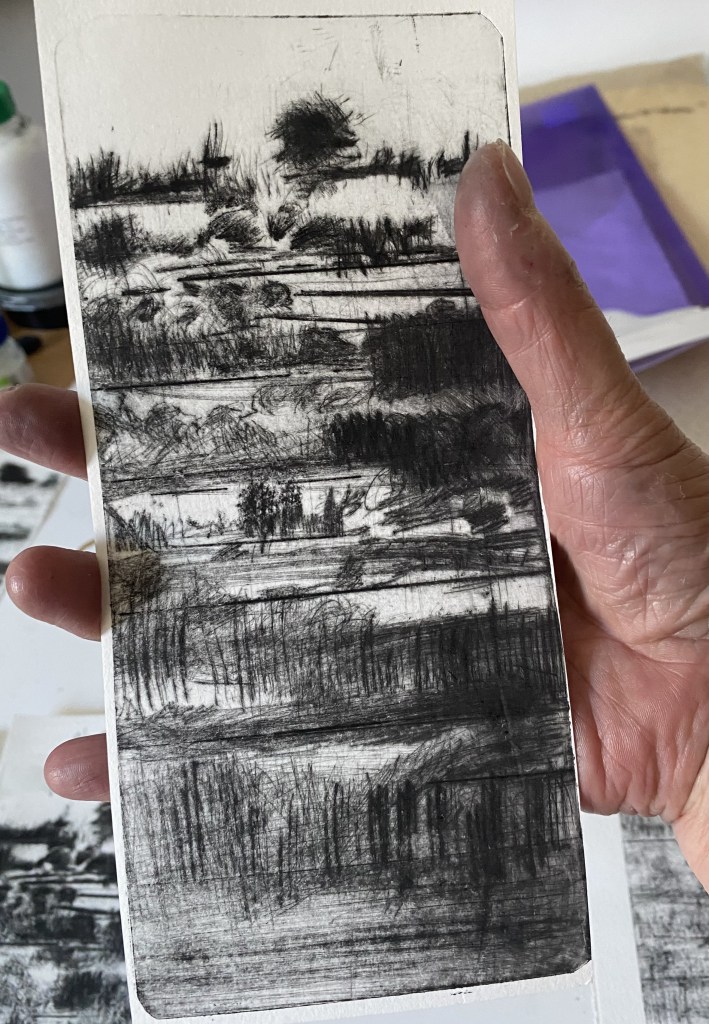
Printmaking: a drypoint that fits in my hand, and a 1 metre vertical panoramic, using paper litho, that doesn’t.

 Carolyn Black
Leave a comment